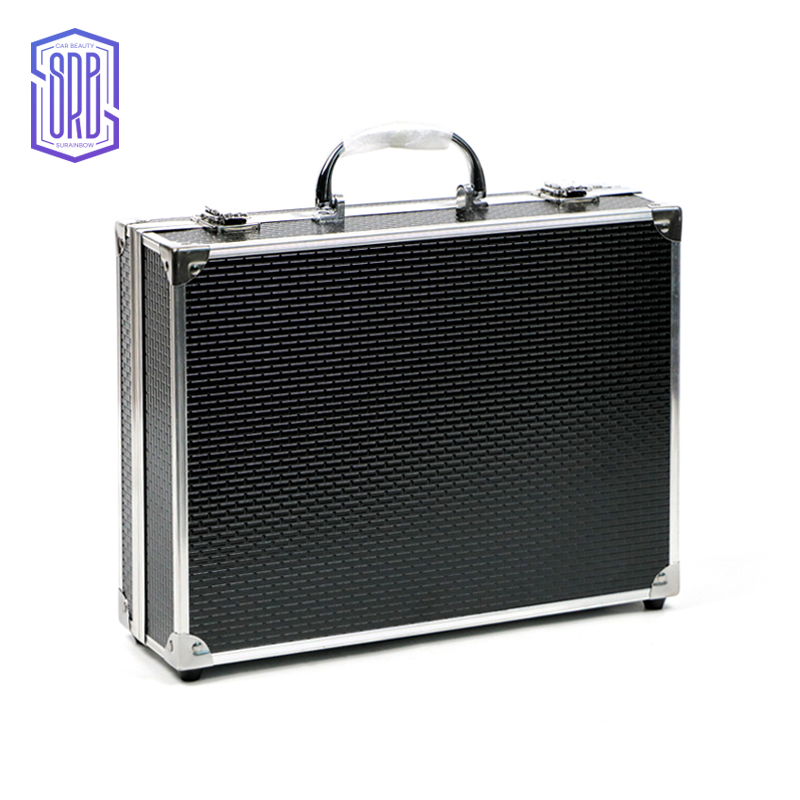
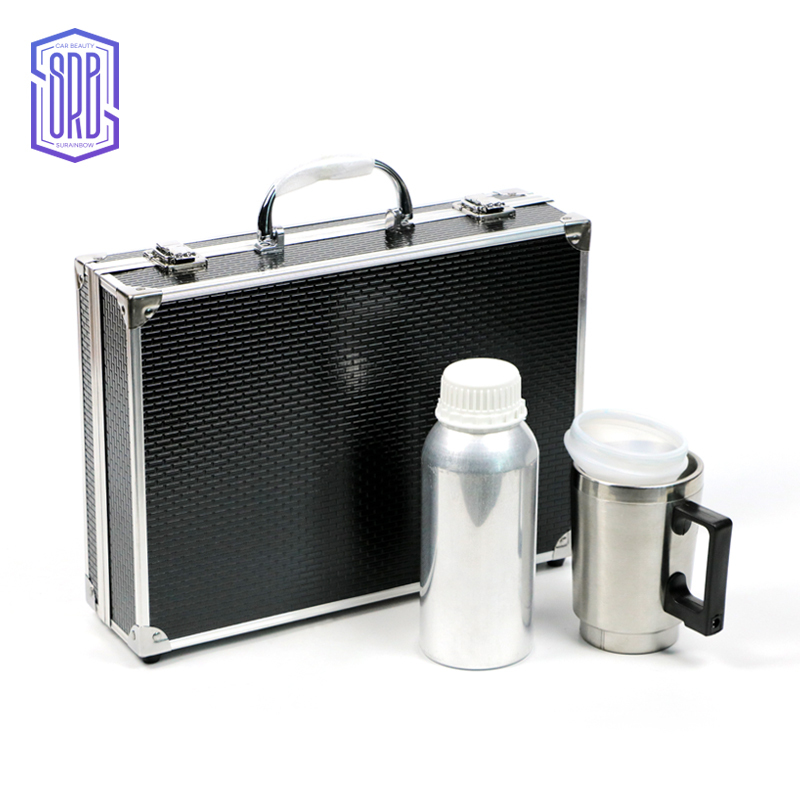
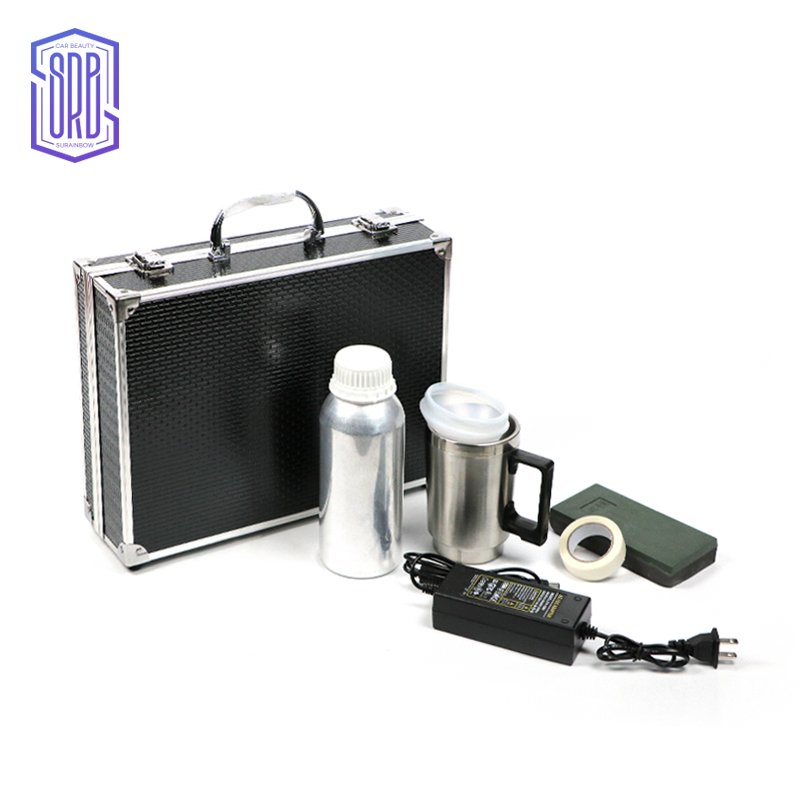
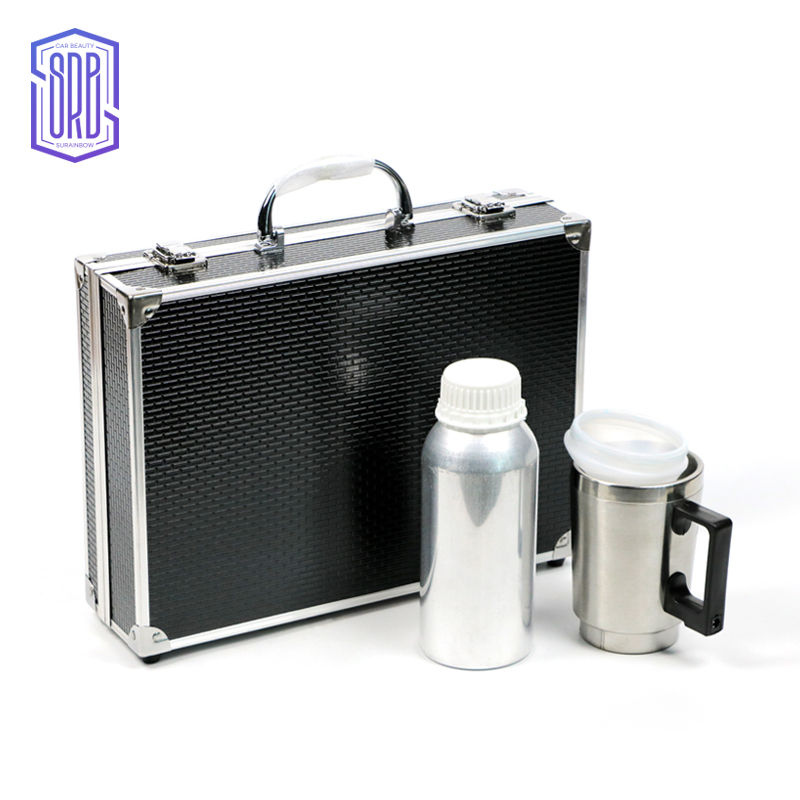
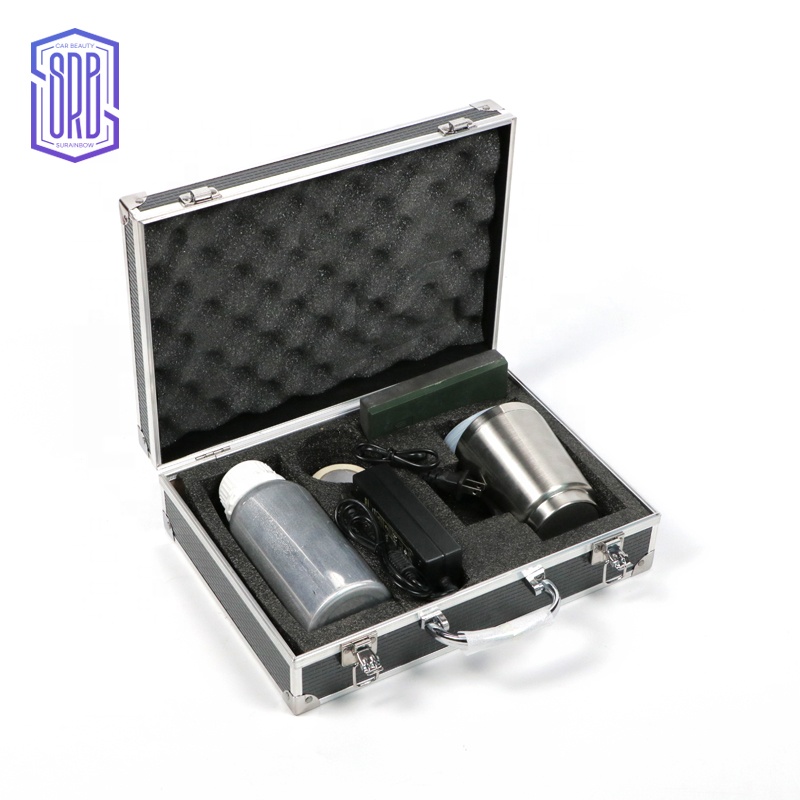
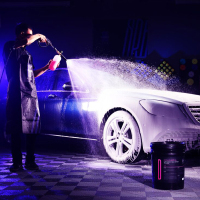
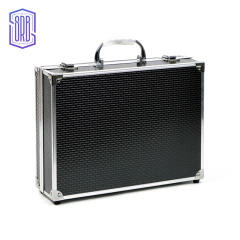
This is our headlight restoration kit, sold under the name car headlight cleaner — a car detailing cleaner put together for the lens stage of a detail rather than for paint or trim. It arrives as one case rather than as a shopping list: the bottle, the steel cup, the hand block, the tape and the power adapter all travel together, held in a molded foam insert. Most car care kits in this part of the catalogue are a bottle and a cloth. Each move has its own piece in the case, which is why a technician can hand the kit to a colleague and get the same process back. Buyers tend to fall into three groups. Detailing studios run headlight work as a fixed service line and want the same pieces every time; distributors and resellers want a case that looks presentable next to the rest of their car care products; dealer prep teams want one item number that covers a complete task on a handover deadline. We are one of the car cleaning products manufacturers based in Guangzhou that supply both the chemical side and the tool side of a detailing bay, so this case can be planned with shampoos, waxes and wash-bay equipment instead of being sourced on its own. It is worth being precise about what the kit does. It treats the outer face of a plastic lens, which is where yellowing and chalky haze normally sit.
Kit Contents & Specifications
Component
Description
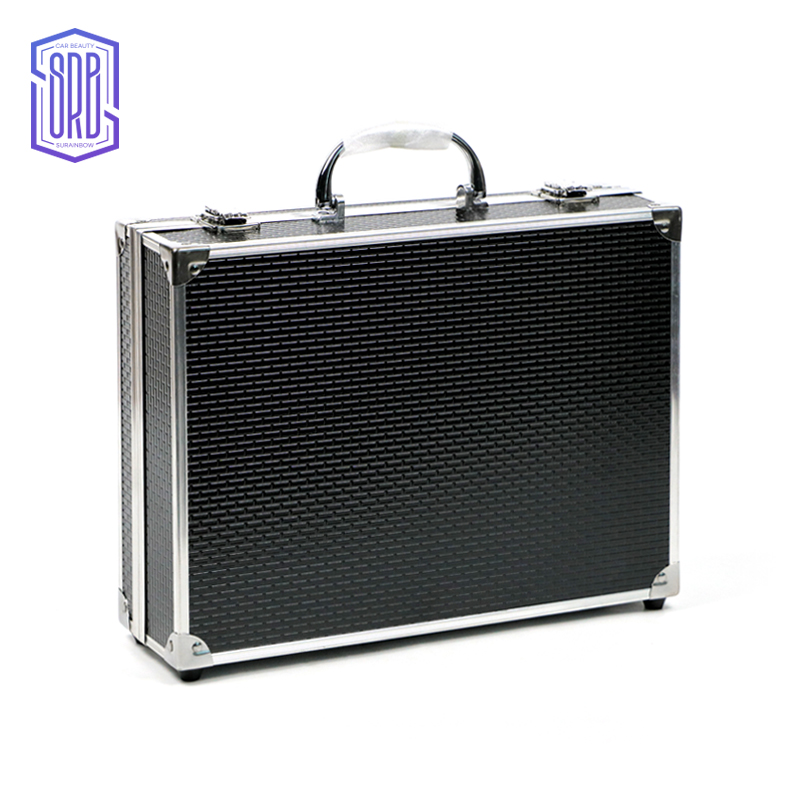
Carrying case
Hard-shell case with chrome trim, hinged lid and top handle
Foam insert
Molded cut-outs that hold each component in its own place
Cleaner bottle
Silver bottle with a white screw cap
Cup
Stainless steel cup with a white lid
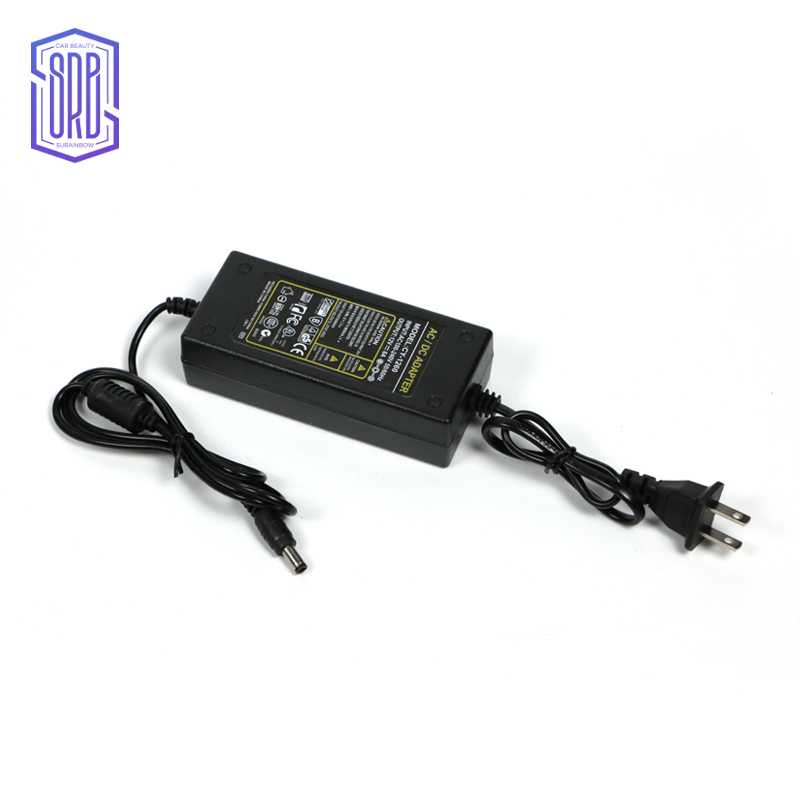
Power adapter
AC/DC adapter with attached cable, barrel connector and two-prong plug
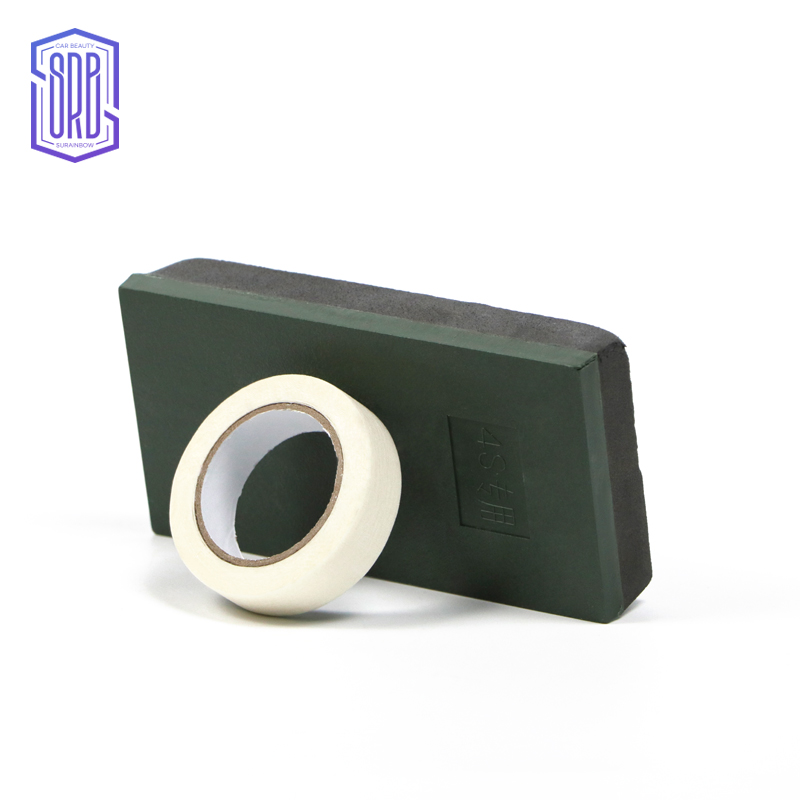
Sanding block
Green rectangular hand block
Masking tape
Roll of beige tape for masking paint and trim
Item number
No.888
Brand
SURAINBOW
Origin
Guangdong, China
Unit weight
2 kg
Application
Car headlight
Recorded function
Anti-scratch
Recorded use
Car paint coating
Lens Condition & Surface Check
Yellowed or chalky polycarbonate: the case this car detailing cleaner is built for, and the one where the full sequence pays off.
A peeling factory coating: the flaking film has to come off first, so plan the working step around removing it rather than treating on top of it.
Cracked, chipped or stone-holed lenses: restoration will not close a break, and a replacement unit is the honest answer to the customer.
Moisture inside the housing: that is a failed seal, not a surface problem, and cleaning the outside will not clear it.
Glass headlights on older vehicles: glass does not haze the way polycarbonate does, so the kit is not aimed at them.
Uncoated or unknown aftermarket lenses: test a small area at the edge first and check the result before working the whole lens.
A lens that has already been worked: if a car polish has been used on it before and the haze has come back, the surface may need more from the working step than a light pass.
Paint and textured trim next to the lens: keep the liquid off fresh paint and off black plastic until you have confirmed it on a test piece.
Restoration Workflow
Wash and dry the lens before anything else.
Road film, bug residue and old wax sit on the surface and get driven into the plastic if the block goes on first; a normal pass with your car wash cleaner and a clean towel is enough to start from.
Mask the paint and trim around the lens with the tape from the case.
Two strips along a bumper edge and over the wing take seconds and stop the block or the liquid touching paint you are not working on.
Work the lens with the hand block, keeping its face flat against the plastic.
Overlapping passes one way and then across keep the surface even; rocking the block on a corner digs a hollow that shows up under light.
Clear the dust before the liquid goes on.
Dust left in the gap between lens and bumper turns into a grey edge line once the cleaner is applied, so wipe the lens and brush or blow out the seam first.
Apply the cleaner from the bottle exactly as the label directs.
Work a small area at a time and follow the application and dwell figures that come with the kit rather than guessing at them.
Inspect under a raking light, then repeat where needed.
A torch held at a low angle across the lens shows the haze first; bring the whole lens to the same finish before you move on.
Finish with your normal protective stage.
Where the process calls for a car polish or a coating afterwards, apply it now so the lens leaves the bay protected rather than bare.
Record what you did.
Note the lens condition before and after and how long the job took — that record is what lets a studio price headlight work as a fixed line item instead of quoting it fresh each time.
Applications in the Detail Bay
Used-car prep is the most common place this kit earns its money. A hazed lens makes a three-year-old car look older than it is, and a prep team working to a handover deadline can add the lens step to the valet without sending the car anywhere.
Detailing studios put headlight work on the menu as a fixed item, usually priced next to the interior and the car wash cleaner stage, and source the case from car cleaning products manufacturers rather than piecing it together. The case is what makes that possible: the same pieces and the same order of work every time means the job can be quoted and repeated rather than improvised.
Mobile detailers like the format. The hard case closes on a wet bottle and a dusty block, the adapter is one unit rather than a bag of parts, and the whole kit sits in the van without being decanted into unlabelled bottles.
Distributors and resellers get a kit that looks like a kit. A hard case with a foam insert and chrome trim does shelf work that a bare bottle cannot, which matters when car care supplies are chosen from a trade counter.
Fleet, rental and taxi operations run the same lens job across a mixed fleet. One item number, one case per technician and a recorded sequence keep the work consistent when different people do it — and car care kits that carry their own method are easier to hand over than a shelf of separate parts.
Storage & Shelf Life
Three years from the production date: that is the shelf life recorded for this item — long enough to hold stock across a season, not long enough to ignore.
Date the cartons when they land.
Store upright, caps tight: a bottle that leaks inside the case soaks the foam insert, and the insert is what keeps the pieces from rubbing together in transit.
Keep cases cool and out of direct sun: warehouse heat is the usual reason behind swollen bottles and softened tape, and stock from car cleaning products manufacturers kept in a hot corner ages faster than the same stock stored in shade.
Leave the foam insert in place: it is cut to the components, so it holds the bottle, cup and block apart while the case is carried and stored.
Rotate first in, first out: put the oldest cartons at the front so a season's worth of car care supplies does not pass its date behind newer deliveries.
Keep the tape dry and grit-free: a roll that has picked up dust will not seal against paint, and masking is the step that protects the customer's bumper.
Check the plug before dispatch: the adapter is the one part of the kit that has to match the socket in the destination market.
Ordering & Delivery
Send the brief.
Destination market, sales channel, quantity, the pack and label you want, and the plug standard your market uses.
Sample and approve.
Ask your sales contact about sample availability and evaluate the kit on a test lens in your own workshop, recording the conditions you used.
Sample scope and any courier charges are confirmed before dispatch, and an approved sample can be sealed as the reference for bulk.
Proof the packaging.
Case branding, label content, carton marks and barcodes are approved before production starts, so the version that goes into the run is the version you signed off.
Confirm the commercial details.
MOQ is set by the item and the pack you choose, and lead time depends on stock position and on whether the case or label is being customised; confirm both with your sales contact before you set a launch date.
Production and records.
Work runs against the approved sample and written specification, and batch records, inspection records and retained samples can be kept for your order.
The kit sits inside a range of car care products that also covers washing chemicals, coatings and waxes, so it can be planned alongside the rest of your programme; tell your sales contact which records you need.
Balance, shipment and documents.
In stock and fast shipping covers most repeat orders, and this case can travel in the same shipment as your car wash cleaner and shampoo lines; the balance is settled before dispatch, and the shipping method, carton marks and consignee details are confirmed together.
Cases are packed 12 to a carton, and mixed orders are consolidated after each line is checked.
Documents for your market.
Invoice, packing list, SDS, CoA and label files are handed over with the shipment; confirm the document list your market requires during quoting, because import requirements differ by market.
After-sales and batch traceability.
Report leakage, shortage or packaging damage within 7 days of receipt, and product-quality concerns within 30 days, quoting the order reference, batch number, affected quantity and photos.
The batch number on the carton is what links a query back to the production records.
Scale & Supply Capability
SURAINBOW is run by Guangzhou Liangdian Automotive Supplies Co., Ltd., a factory-trade operation set up in Guangzhou in 2010 and now 50 people strong. Sixteen years in car care have given us a one-stop supply position: our own SURAINBOW lines are held in stock for fast shipping, and an associate factory with modern production equipment and an established quality management system keeps replenishment moving. We take OEM and ODM work and our R&D team develops to your specification. Buyers in the Middle East, the United States, Southeast Asia, Europe, the UK, Russia, Africa and Australia already order from us.
FAQ
Do the headlights have to come off the car?
No. The kit is laid out for on-vehicle work, and the masking tape in the case is there to protect the paint and trim around a lens that stays on the car. Removing a lamp only makes sense when the housing has to come apart for a separate repair, which is a different job from surface restoration.
Can the same kit be used on tail lights and other clear plastic parts?
Tail lights, indicator lenses and clear plastic trim are made from similar plastics and haze in a similar way, so the sequence carries over. Run one small area first and check the result before committing a whole set — a car detailing cleaner used on the wrong plastic can dull a surface rather than lift the haze, and the test costs a minute.
How is this different from a bottle of car polish?
A bottle of car polish is one step in a bigger job. Most car care kits stop there; this one also carries the masking tape, the hand block, the steel cup, the bottle and the case, so the whole sequence travels as one item and two technicians can run the same process on the same day.
Can we reorder the liquid on its own?
Ask your sales contact whether the cleaner is available as a separate refill item and in which pack size. A studio running several lens jobs a week will get through the liquid before the case wears out, so it is worth planning refills alongside the kit order rather than after the last bottle runs dry.
What should we check on the kit before it goes on our shelf?
Three practical points: the plug standard for your market, the current contents list for the case, and the application instructions that ship with the bottle. Confirm all three with your sales contact and run a sample on a test lens before a first order of car care supplies is released.