Product Overview
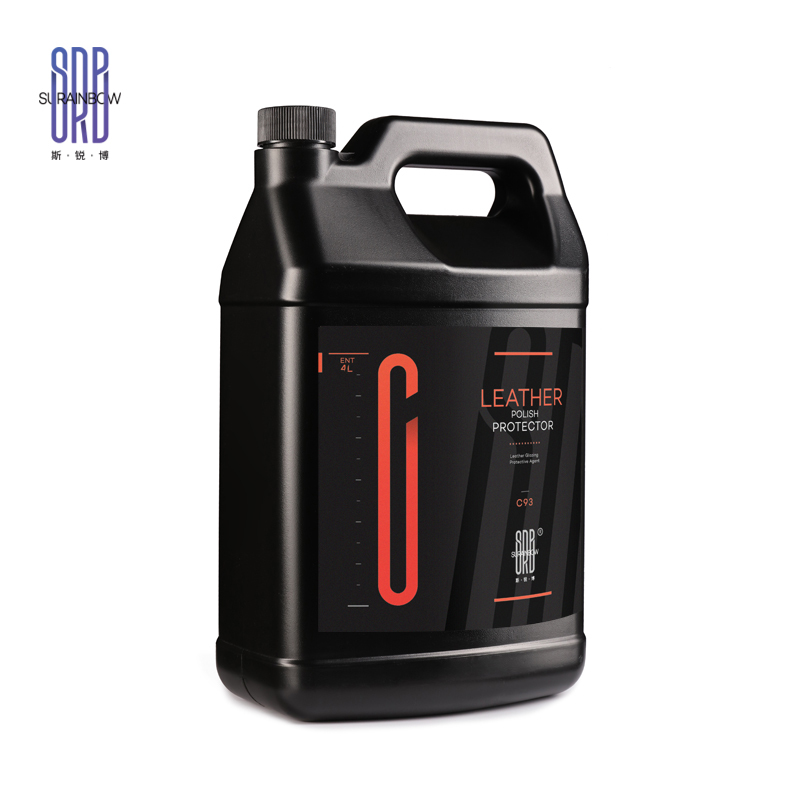
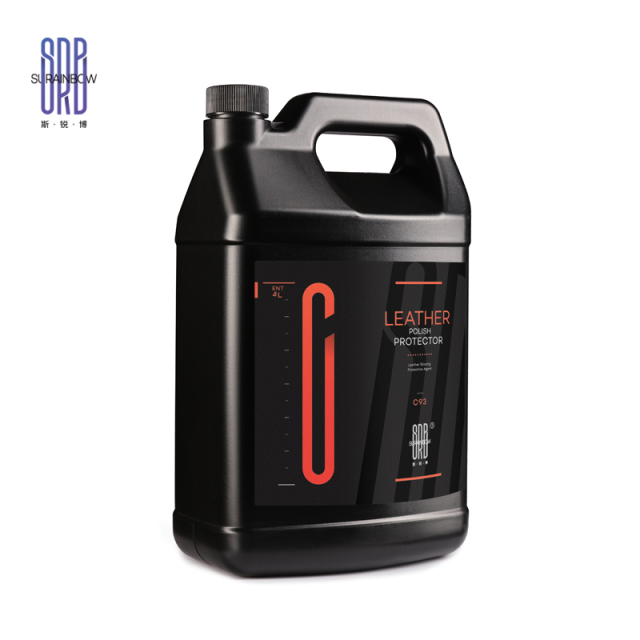
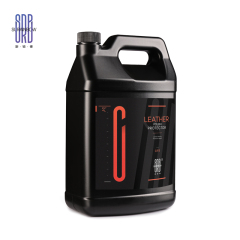
Four liters fills a working jug designed for professional use: SRB leather polish protector is a leather polish protector built for workshops that treat leather every week, whether that is a detailing bay, a used-car reconditioning line or a distributor's leather-care operation. It conditions and rejuvenates automotive leather, restores a soft hand feel and adds UV protection against sunlight passing through vehicle glass, so seats, bolsters and door cards return to a maintained finish instead of looking dry and tired.
The format is part of the product. A 4 liter leather polish jug supports a workshop through a run of interiors without constant reordering, and it is easy to move between cars and to decant into bench bottles for work at the vehicle. Buyers who want one pack size across a workshop and a resale line tend to standardise on this one.
Where it sits in the routine matters as much as what it does. It is the conditioning and protection step, applied once the leather has been cleaned and before the car goes back to the customer, so it belongs in a maintenance menu rather than in a repair bay. Detailing chains, dealers, fleet teams and importers all use it in that slot, and it is produced under the SURAINBOW label by a Guangzhou leather protector manufacturer that also supplies the cleaners and applicators that go with it.
Applications
- Used-car reconditioning: seat cushions, bolsters and door cards come up with an even, cared-for finish before photography and viewings, so worn leather reads as maintained rather than neglected.
- Detailing service menus: it is the protection step sold after a leather clean, and it does not replace a leather coating service that a customer has booked separately.
- Dealership and showroom preparation: a thin, buffed application on delivery-day interiors keeps seats looking uniform without the wet gloss that greasy dressings leave under showroom lighting.
- Fleet, rental and taxi interiors: armrests, bolsters and door pulls gain the most from the anti-stick film, because those are the panels that collect body oils and dye transfer first.
- Upholstery and trim shops: retrimmed seats and new leather covers are finished with it before handover so the hide feels soft from the first day instead of stiff.
- Distribution and resale: importers and wholesale buyers looking for a leather polish supplier for a leather-care shelf take the 4 liter pack as a stock line beside cleaners, applicators and microfiber.
Application Steps
- Cleaning comes first — dust, body oils and old dressing have to come off with a leather cleaner and the surface has to dry, or the film seals them into the hide.
- Check one hidden panel — the inside of a bolster or under the seat shows how that particular hide takes the product and how much you need.
- Load a clean sponge or microfiber towel — pour a small amount onto the applicator instead of onto the seat, so the product stays on the panel you are working.
- Work one panel at a time — massage the liquid into the grain in overlapping passes until the surface looks evenly damp rather than wet.
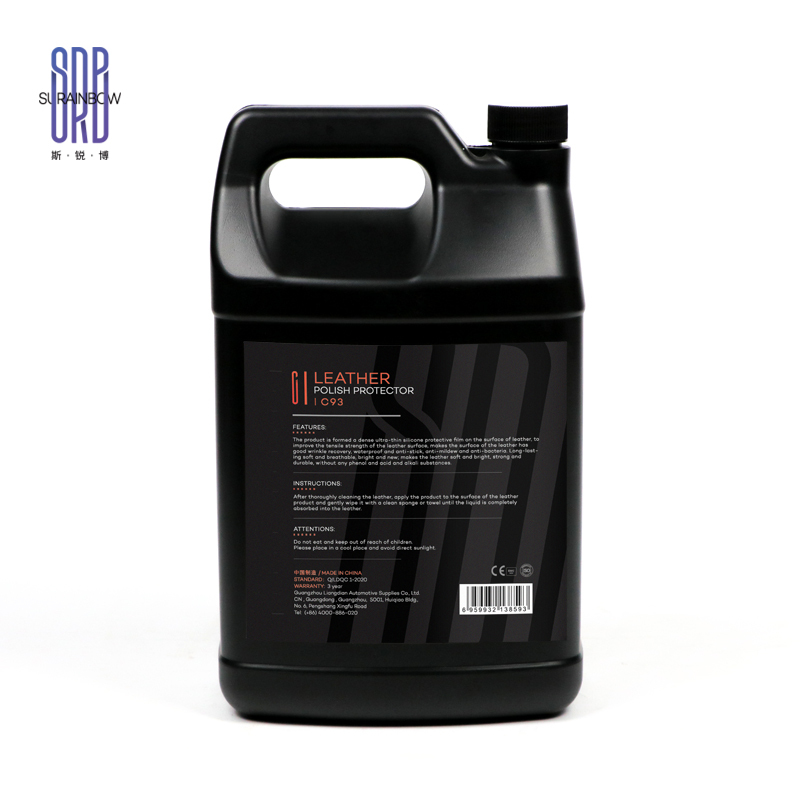
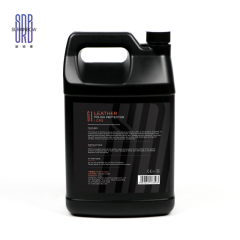
- Wipe until it is absorbed — the pack instructions call for gently wiping with a clean sponge or towel until the liquid has been taken in, then buffing off any excess with a dry towel.
- Let the panel settle — give the leather time to dry before the car goes back into service and keep the cabin ventilated while it does.
- Buff once more at the end — a dry microfiber pass after drying evens out the finish and lifts fingerprints left during application.
The Protective Film
A dense, ultra-thin silicone film is what separates this from a conventional leather dressing. It is laid down on the surface of the hide in a layer thin enough that the grain stays visible and the leather keeps breathing, so an interior does not end up sealed under a heavy conditioner.
Water repellency and anti-stick behaviour come from that same layer. Rain, spills and coffee bead on the surface for a moment instead of soaking straight in, and dust, lint and light soiling do not grip the leather the way they do on an untreated hide, which makes the next interior clean noticeably quicker.
Wrinkle recovery is the part most detailers notice first. Seat bolsters and cushion edges hold fine creases after months of use; the film is formulated to improve the tensile strength of the leather surface so those creases relax more readily and the panel presents smoother.
Thin does not mean short-lived in service. Because the film is renewed with each maintenance application it stays consistent across a vehicle's life, and it is thinner than the film a leather coating leaves, so a coated, built-up feel never develops on the hide.
Mildew and bacteria resistance is part of the product's stated feature set. Where a market needs written support for that or for the durability statements, request the available test documentation for the batch with your order.
Specifications
| Product name | SRB leather polish protector |
| Product code | C93 |
| Pack size | 4 liters |
| Form | Liquid polish and protector |
| Working mechanism | Dense, ultra-thin silicone protective film |
| Intended surface | Automotive leather |
| Free from | Phenol, acid and alkali substances |
| Applied with | Clean sponge or microfiber towel |
| Container | Opaque jug with integrated carrying handle and screw cap |
| Product standard | Q/LDQ 1-2020 |
Use, Care & Handling
- Ready to use as supplied: the pack instructions describe wiping the liquid into clean leather with a sponge or towel until it is absorbed, and there is no dilution step, so it goes on neat from the jug.
- Aniline, unfinished and worn-through leather: these absorb liquids differently from pigmented automotive leather and can darken, so treat them as a separate job and confirm suitability before working a full panel.
- Two-tone and contrast-stitched interiors: keep the application even and work the product away from the stitching line, because residue that collects there dries pale against a darker thread.
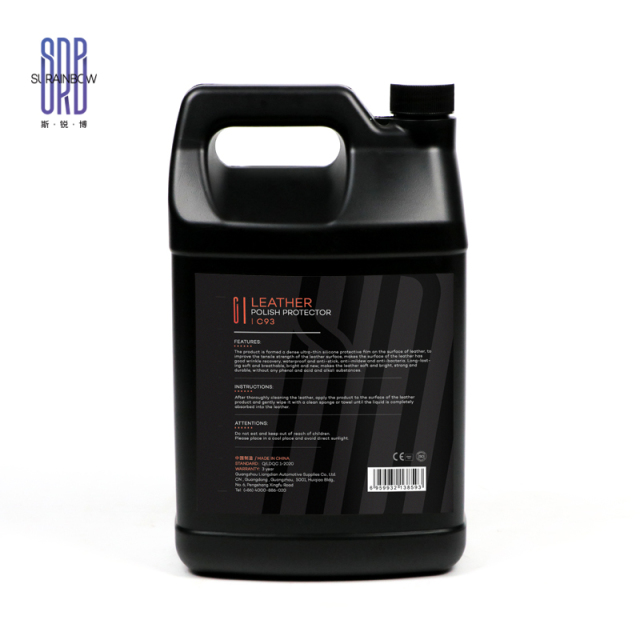
- Storage and safety: keep the jug capped in a cool place away from direct sunlight, and keep it out of reach of children — the pack carries a do-not-eat warning and it is not a food or beverage container.
- Decanting for bay work: bench bottles are easier to handle around a car, but label them and copy the batch reference from the original jug so a later question can be traced.
- What it will not do: cracked, split or worn-through leather needs repair rather than conditioning, and the film improves the look and feel of intact hide without rebuilding a damaged surface.
Ordering & Delivery
- One brief starts the order — pack size, quantity, destination, label choice and the surfaces the product will be sold for, plus any leather cleaners, applicators or towels you want quoted alongside, so one leather polish supplier can cover the whole leather-care line.
- Approve a sample before bulk — test the finish on your own leather and seal the approved piece as the reference the production batch is compared against.
- Confirm artwork and packing — label wording, warnings, barcode and carton marks are proofed against the approved sample before production; as the leather protector manufacturer we issue the pack and label specification your artwork has to match.
- Agree the commercial detail — minimum order quantity is set around the pack format and the total order plan, so it is quoted for your specific requirement rather than fixed as one figure here.
- Plan the dispatch — in stock and fast shipping is our standard position on regular items, and the method, consignee details and carton marks are confirmed before anything leaves.
- Prepare the documents — tell us which safety data sheet, composition statement or label document your market requires, and the set is prepared with the shipment; local registration and labelling obligations stay with the importer.
- Keep the batch reference — if a jug arrives leaking, short or out of specification, send the batch number, the quantity affected and photos so it can be checked against the production and retained-sample records.
Sheen & Hand Feel
Buffing fixes the look, and the finish lands closer to satin than to the wet gloss a heavy dressing leaves behind. Worked in and buffed dry, the surface still shows grain and texture, so black leather keeps its depth, grey stays even and a light beige hide does not go chalky at the panel edges where product collects.
Touch matters as much as appearance. Once the panel has dried, SRB leather polish protector leaves a surface that feels dry and smooth rather than slick or tacky — a hand slides across a bolster or armrest instead of catching. That is what stops the finish grabbing dust on the drive home and marking a customer's clothing at handover.
Colour stays where it was. This is a polish and protector, not a pigment: it does not darken leather artificially, and it will not cover fading, scuffs or dye transfer. What it does is even out the tired, dry look across a cushion so the panel reads uniformly under showroom lighting.
Creases and high-wear edges change more subtly. Bolsters and cushion edges that looked crumpled settle as the surface firms, and the hide feels softer under thumb pressure without turning spongy. Two things decide the final feel — how much product went on and how thoroughly it was buffed — so a heavy coat left unbuffed is the one reliable way to end up with a greasy panel from this jug.
Judge it the way your customers will: a maintenance finish that feels close to the original hide, soft and breathable rather than coated and built up. Buff a scrap panel or an inconspicuous bolster first, let it dry, and look at it in daylight before a full seat goes on the schedule.
Scale & Supply Capability
We are Guangzhou Liangdian Automotive Supplies Co., Ltd., an integrated manufacturing and trading company founded in Guangzhou in 2010. With 50 employees, we supply a broad range of car care products to distributors, wholesalers and brand owners. Our range lets you source across categories through one supplier, with in-stock options and fast shipping. Alongside our SURAINBOW brand, we offer OEM/ODM customization, supported by a professional R&D team that can design and develop products around your requirements.
FAQ
Is SRB leather polish protector a leather coating?
No. This leather polish protector conditions the hide and leaves an ultra-thin, breathable film, while a leather coating cures into a harder, longer-lasting layer applied as a separate technical service. Shops that sell both usually offer the coating as an upgrade and keep the protector for the conditioning work between coating jobs.
Can it be used on perforated or ventilated seats?
A sponge is the better applicator there. Load it lightly and work the product into the leather around the perforations, then buff the panel with a dry towel so nothing sits in the holes and dries into a pale ring. On perforated hide, thin and even beats a heavy coat.
How far does a 4 liter leather polish go?
There is no single figure that holds across vehicles. A tightly finished seat draws far less product than a dry, porous or heavily grained hide, and a three-row interior takes more than a two-seat cabin. Most shops decant into a bench bottle and log the amount used per car for a month, which gives them a real cost per vehicle instead of an estimate.
Will it change the colour or leave a greasy shine?
Buffed properly it leaves a soft, even sheen rather than a wet gloss, and the film is clear and thin enough that the grain still shows through; on standard pigmented automotive leather the colour stays as it is. This is a polish and protector, not a dye or a pigment, so it will not cover fading or disguise scuffs.
What does it feel like on a steering wheel or gear knob?
High-contact leather is where the anti-stick film is most noticeable, because the surface stays smooth and dry rather than tacky and hands do not drag on it. Apply thinly and buff afterwards, since excess product is what makes any leather treatment feel slick in the hand.
How is this different from the 500 ml dashboard protection spray?
The dashboard spray is a 500 ml format aimed at dashboards and the mixed interior surfaces it lists, while this is a leather-focused polish protector in a 4 liter working pack for shops treating seats, bolsters and door cards week after week. Where leather volume is the job, the 4 liter pack carries the work; the 500 ml spray suits a mixed interior kit.